Technology

One autonomy stack, four bodies

We build the intelligence once — perception, mapping, planning, and safety — then adapt the hardware to each job. The result is faster development and consistent, predictable behaviour across the whole fleet.

The Stack

Four layers, every machine

Layer 01

Perception

LiDAR and camera sensor fusion build a live 3D picture of the world — robust to dust, glare, rain, and darkness.

Layer 02

Mapping & Localization

Real-time SLAM and RTK-GPS keep each robot localized to within a few centimetres, indoors or out.

Layer 03

Planning & Safe Motion

Path planning with dynamic obstacle avoidance and safety-rated stops — people always have right of way.

Layer 04

Fleet & Telemetry

A single dashboard to task robots, watch live telemetry, and push over-the-air updates across the fleet.

Safety First

Designed to stop before it has to.

Autonomy only earns trust when it is safe. Every Microhard platform carries redundant sensing and braking, and every behaviour is validated before it ships.

  • Redundant emergency stops — hardware and software
  • 360° obstacle detection with protective stop zones
  • Teleoperation fallback for edge cases
  • Full audit logs for every autonomous decision
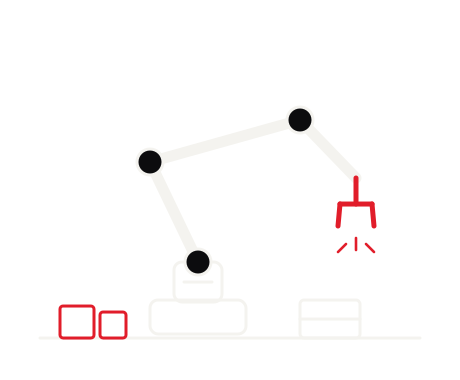
Line drawing of a robotic work cell
How We Build

From concept to deployed fleet

Step 1

Discover

We study your site, workflow, and constraints to define the job and success metrics.

Step 2

Prototype

We adapt a platform, integrate sensors, and validate in simulation and on a test track.

Step 3

Pilot

A supervised pilot runs on your site, tuning behaviour against real conditions.

Step 4

Scale

We deploy the fleet, connect telemetry, and support it with OTA updates.

Curious how the stack handles your environment?

Bring us a site map or a workflow and we'll talk through perception, safety, and integration.

Start a conversation